
Somewhere right now, a creator has made something genuinely good — a repair tutorial that solves a problem thousands of people are stuck on, a health explainer that untangles something confusing, a coding lesson that finally makes a concept click. It is well produced, well argued, and correct. And outside the language it was recorded in, almost nobody will ever see it.
This is not a quality problem. It is a distribution problem wearing a quality problem's clothes. Even counting every person who speaks English as a first or second language, generously, the total tops out around 18 to 19 percent of the roughly 8.1 billion people on Earth. No other single language clears that bar either. Which means the overwhelming majority of the internet's best work, in any language, is structurally invisible to most of the planet — not because it is not good enough, but because it was never translated into a form the rest of the world could actually receive.
The direction that gap runs is worth being precise about, because it is not the one-way story it is often assumed to be. Something built by a well-resourced team in the United States or the Netherlands can, in principle, reach someone who needs it in Armenia — but the reverse has always been just as true, and just as often blocked by the same barrier. A creator in a smaller-language market with a genuinely good piece of work has had no realistic path to a large-language audience either, for the same reason the tutorial above stays invisible: not a lack of quality, a lack of an affordable way to move across the language line. Whatever closes that gap has to close it in both directions to actually matter, and that symmetry is a theme worth watching for throughout the rest of this piece.
AI dubbing is one of the technologies closing that gap, but understanding it requires more than knowing that software can replace one voice track with another. A complete video-translation system begins with multilingualism as an operating requirement, passes through transcription and subtitles, and ends with synchronized, reviewable media that can be published and maintained at scale. This piece follows that full chain, including where native platform dubbers still fail, what enterprises require beyond a one-video workflow, and how Octavia can serve as the video-translation layer inside that process.
What Multilingualism Actually Means

Multilingualism is often reduced to a capability count: a person speaks three languages, a platform supports thirty, a model generates sixty. That count is useful, but it is not a sufficient definition. Multilingualism is the ability of a person, community, product, or organization to operate across more than one language while preserving meaning, access, and continuity. For video, it is not a property of the audio track alone. It spans everything a viewer encounters before, during, and after playback.
There are four levels worth separating. Individual multilingualism describes a person's ability to understand or use multiple languages, usually at unequal levels of proficiency. Societal multilingualism describes several languages coexisting within a country, institution, or audience, where language choice can communicate identity, region, age, or social context. Content multilingualism means one intellectual work exists as coordinated versions across audio, captions, titles, descriptions, thumbnails, on-screen text, and supporting documents. Operational multilingualism is the enterprise version: the organization can create, review, publish, update, measure, and govern those versions repeatedly without rebuilding the workflow for every language.
That last distinction is the one most product claims miss. A platform can advertise sixty supported languages and still provide a weak multilingual system if it cannot preserve terminology across a course, distinguish regional variants, identify which source revision a dub came from, or route a sensitive translation to the right reviewer. Language coverage describes what a system may generate. Operational multilingualism describes whether the resulting catalog remains usable and trustworthy.
Several terms recur throughout that workflow. The source language is the language present in the original media; the target language is the language being produced. A locale adds regional conventions to a language, so Spanish for Spain and Spanish for Mexico are not operationally identical targets. A dialect concerns a regional or social variety of a language, while register describes choices such as formal, conversational, technical, or playful speech. Code-switching is movement between languages within the same conversation or sentence. A low-resource language is one for which comparatively little usable training and evaluation data exists. These are not academic labels pasted onto a creator workflow. Each one can change transcription accuracy, translation choices, pronunciation, voice performance, and who is qualified to approve the result.
This leads to a more demanding definition of success. A multilingual video is not simply a video for which another audio file exists. It is a video whose meaning, voice, discoverability, accessibility, and version history continue to work in another language. AI dubbing supplies a crucial part of that system, but transcription and subtitles come first.
Why Language Has Always Been Such a Hard Barrier

Language is not a soft inconvenience that subtitles or a search-box translation tool can quietly route around. It is a barrier built from three constraints that compound rather than substitute for each other, and each one is expensive on its own terms before the other two even enter the picture. Understanding why it has been this hard is what makes the rest of this piece land as more than a general claim that "AI makes things easier."
The first constraint is individual: becoming competent enough in a language to translate it professionally takes years, not weeks, per language. The US Foreign Service Institute's language-training data, drawn from more than seventy years of teaching diplomats, sorts languages into four difficulty categories for native English speakers. Category I languages — French, Spanish, Italian, Portuguese, Dutch — take 600 to 750 classroom hours to reach professional working proficiency, delivered at a pace of 25 hours of class plus 15 to 17 hours of homework per week. At that full-time intensity, that is roughly six to seven months; for anyone learning part-time alongside a job, the realistic timeline runs one to two years. Category IV languages — Mandarin, Arabic, Japanese, Korean, Cantonese — require 2,200 classroom hours, which even at full-time intensity is closer to a year and a half, and for a part-time learner commonly runs four to six years or more. That is the individual-level cost of one person becoming professionally capable in one additional language, under the most favorable conditions the US government's own training data documents.
The second constraint is production: even once a qualified translator exists, turning a translation into a finished dubbed video is its own expensive, multi-stage process. Published industry guides commonly place mid-range professional dubbing around $20 to $40 per finished minute, with premium studio work starting above that and custom film or broadcast production varying much more widely. Plain text translation is a separate and smaller input cost, commonly priced by source word and influenced by language pair, specialization, and urgency. A single hour-long video translated, cast, recorded, directed, mixed, and reviewed in several languages can therefore move from thousands into five figures, while each language remains its own production and approval cycle.
The third constraint is scale: there are far more languages than there are people and studios able to do this work. Ethnologue's most recent count puts the number of living languages in the world at roughly 7,170. Even a company with a global production budget rations which titles get dubbed into which languages — in a corpus of Netflix's own English-dubbing decisions referenced later in this piece, only 4 percent of licensed, non-original films were dubbed into English, against 44 percent of Netflix's own productions, and certain culturally dense comedies were deliberately left subtitle-only because dubbing was, in the researchers' own words, reserved for titles expected to draw a large-scale general audience given its cost relative to subtitling. For an individual creator, the realistic number of languages reachable through traditional per-language production relationships is close to zero — not because the audience in those languages does not exist, but because the first two constraints compound across every additional language instead of getting cheaper with scale.
These three constraints do not simply stack — they multiply. A language with a modest speaker population, a high per-minute production cost, and no existing translator relationship is not merely hard to reach three separate ways; it is effectively unreachable, full stop, for anyone without a large, dedicated localization budget. And that combination describes most of the roughly 7,170 languages on Ethnologue's count, not a handful of rare edge cases. The languages a traditional media company can afford to dub cluster tightly around a small number of large, well-resourced markets, which is exactly the mismatch described in the opening of this piece: a supply of translated content shaped by production economics, not by where the audience actually is.
To make this concrete, consider a single hour-long video a creator wants available in five additional languages. Learning even one of them to a professional working level is a long undertaking, and learning all five is not a realistic production strategy. At an illustrative mid-range dubbing rate of $30 per finished minute, five target languages cost about $9,000 before extra review, difficult casting, revisions, or project management. A modest increase in the per-minute rate pushes the same project past $10,000. Multiply that by a weekly publishing cadence or a growing course catalog, and the traditional cost structure becomes incompatible with how most individual creators and small teams operate.
This is where the "invisible tariff" language used above gets its receipts. Years of study, per-language production cycles, and a limited supply of qualified people and studios shape which work crosses a language boundary. AI video translators replace much of that sequential production with credit- or usage-based processing and targeted human review. The exact cost still depends on duration, target-language count, plan, and review labor, but the production model is different enough to make repeatable localization accessible to teams that could never sustain a studio workflow.
What Is Transcription?

Transcription is the conversion of speech into text. In an AI video-translation pipeline, however, the useful output is not a plain paragraph. It is a time-aligned representation of what was said, when it was said, which speaker said it, which language they used, and where the system is uncertain. That representation becomes the data layer from which subtitles, translations, generated speech, search indexes, chapters, and review interfaces are built.
Automatic speech recognition, or ASR, normally produces the words. Other components identify where speech begins and ends, detect the source language, restore punctuation and casing, divide the text into usable segments, and separate speakers through a process called speaker diarization. A production transcript may therefore contain word- or segment-level timestamps, speaker labels, confidence information, and normalized forms of numbers, dates, acronyms, and names.
Transcription is also the first semantic bottleneck. If a system hears fifteen as fifty, removes a negation, corrupts a product name, or assigns a sentence to the wrong speaker, the translation system receives false source material. It may then generate a perfectly fluent translation of something the creator never said:

``text audio error → transcript error → translation error → spoken dub error → published video error ``
This is why a single aggregate accuracy score is not enough. Word error rate measures insertions, deletions, and substitutions across a transcript, but an otherwise excellent score can conceal one dangerous error involving a dosage, price, legal condition, safety instruction, or proper noun. For video translation, named-entity recall, number preservation, speaker-attribution accuracy, timestamp accuracy, and the number of manual corrections per finished minute can matter as much as the overall word error rate.
What Are AI Subtitles?

Transcripts and subtitles are related, but they are not interchangeable. A transcript records the spoken content. A subtitle track turns that content into timed reading units designed for a screen. Captions generally represent speech and relevant sound in the source language for accessibility. Subtitles generally translate speech into another language while preserving the original audio. AI subtitles use automated models to transcribe, translate, segment, and time those units.
| Artifact | Audio | Language | Primary job | |---|---|---|---| | Transcript | Unchanged | Usually source | Searchable and reviewable record of speech | | Captions | Unchanged | Usually source | Accessibility, comprehension, and sound representation | | Translated subtitles | Original retained | Target | Let the viewer read another language | | Voiceover | Original lowered beneath narration | Target | Provide translated speech without close visual synchronization | | Dub | Spoken track replaced | Target | Make the translated performance function as the video's speech |
Subtitle production is an engineering constraint of its own. A good cue must appear and disappear at the right time, remain on screen long enough to read, avoid awkward line breaks, respect semantic boundaries, and stay reasonably aligned with shot changes. File formats such as SRT, WebVTT, and TTML can store timed text, but a technically valid file can still be exhausting to read if the translation is too verbose for the available interval.
Subtitles remain useful even when dubbing is the final goal. They provide a visible intermediate representation that a reviewer can correct before speech is generated, and they remain a separate accessibility and distribution asset after the dub is complete. For this reason, an AI video translator should not treat transcription, subtitles, and dubbing as unrelated buttons. They are successive representations of the same content.
What Are AI Video Translators?

An AI video translator is a system that transforms a source video into one or more synchronized, reviewable, publishable language versions. It is broader than machine translation, subtitle generation, voice cloning, text-to-speech, or lip-sync considered separately. AI dubbing is one of its principal outputs; the video translator is the workflow that coordinates the entire transformation.
A typical system moves through the following stages:
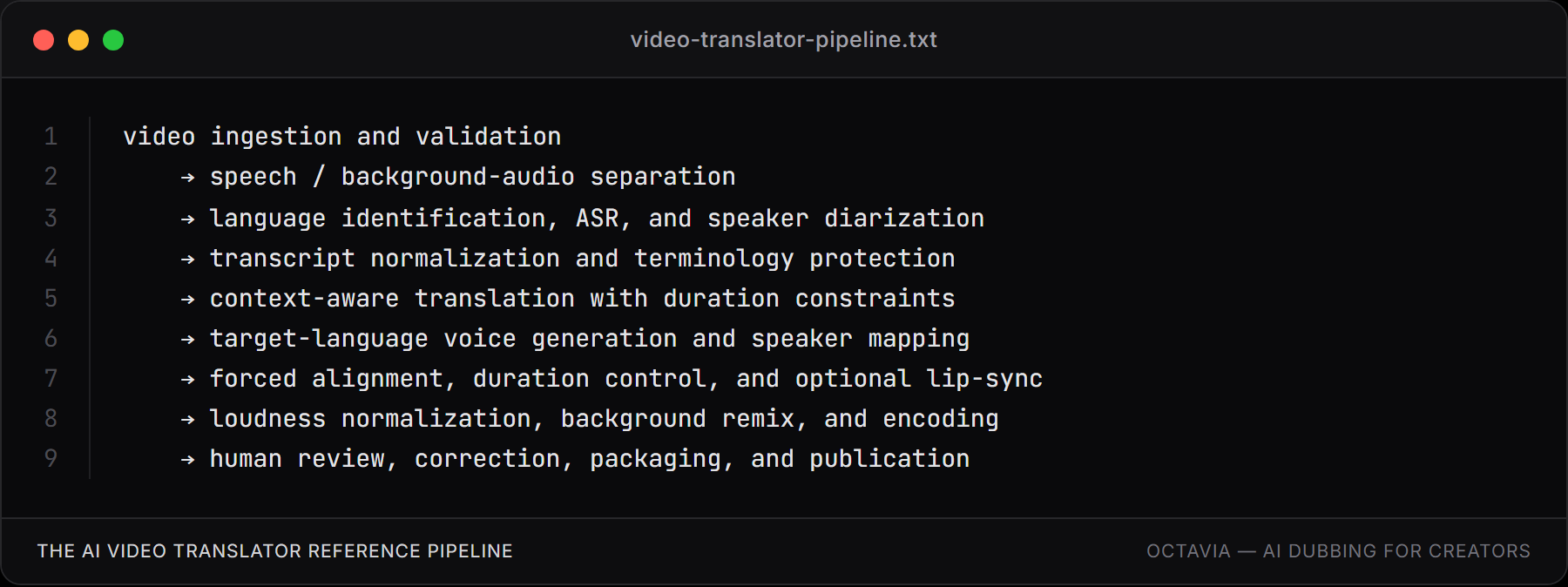
``text video ingestion and validation → speech / background-audio separation → language identification, ASR, and speaker diarization → transcript normalization and terminology protection → context-aware translation with duration constraints → target-language voice generation and speaker mapping → forced alignment, duration control, and optional lip-sync → loudness normalization, background remix, and encoding → human review, correction, packaging, and publication ``
- Ingestion and validation. The service verifies the media format, duration, audio tracks, resolution, and whether the file can be decoded reliably.
- Audio preparation. Speech may be separated from music and ambient sound so translated dialogue can later be remixed without destroying the original soundscape.
- Language identification, transcription, and diarization. The system determines what language is being spoken, creates timed text, and maps segments to speakers.
- Normalization and terminology protection. Names, numbers, acronyms, product terms, and domain language are corrected or protected before translation.
- Translation for spoken delivery. The target text must preserve meaning and register while remaining compatible with the time available for each utterance.
- Voice generation and speaker mapping. Target-language speech is generated in a selected or voice-matched voice, with each segment assigned to the correct speaker.
- Alignment and optional visual synchronization. Audio duration is adjusted to the source timing; some systems also modify visible mouth movement.
- Mixing and encoding. Generated dialogue is combined with background audio, normalized for loudness, and encoded into the required media outputs.
- Review, correction, and publication. Humans inspect the transcript, translation, audio, timing, and packaging before the result reaches a public or internal destination.
Each stage has a characteristic failure mode. Recognition errors propagate downstream. Translation can be literal but culturally wrong. Speaker mapping can attach the right sentence to the wrong voice. Generated speech can preserve timbre while losing emotion. Aggressive duration control can make a sentence rushed, while loose control creates drift. Lip-sync can introduce visual artifacts even when the audio itself is strong. Long-form work magnifies all of these because terminology, speakers, timing, and revision state must remain consistent across hours rather than seconds.
Research on these components predates the current product wave. OpenAI's Whisper demonstrated large-scale multilingual recognition and translation from 680,000 hours of weakly supervised audio. Automatic-dubbing research from Amazon and Fondazione Bruno Kessler formalized length-controlled translation, prosodic alignment, and duration-aware speech generation. Few-shot and zero-shot voice-cloning research showed how a short reference sample could carry speaker identity into synthesized speech, while work such as Wav2Lip addressed visual speech alignment. These papers describe the technical lineage of the category, not the internal architecture of any particular commercial tool.
What an Enterprise-Grade Video Translator Should Return

A rendered video is necessary, but it should not be the only recoverable artifact. Depending on the product and plan, a serious evaluation should ask whether the system can return or preserve the localized video or audio track, source transcript, translated transcript, subtitle file, speaker map, terminology decisions, review state, and machine-readable job metadata. It should also establish whether a reviewer can regenerate one corrected segment without discarding successful work elsewhere.
Quality should be evaluated as a stack rather than a single impression. Useful dimensions include source-transcript accuracy, named-entity and number preservation, translation adequacy, native naturalness, speaker consistency, voice fidelity, emotional range, audio-video offset, accumulated sync drift, loudness, visual artifacts, processing time, retry rate, manual edits per finished minute, and cost per approved target-language minute.
A practical first test is still small: translate the most difficult sixty to ninety seconds of the actual content—not its easiest passage. Choose the section with the densest terminology, strongest emotion, fastest delivery, or most complex speaker exchange. If that sample cannot survive transcription, translation, performance, and timing review, processing the remaining hours only multiplies the problem.
The History and Craft of Dubbing

Dubbing predates modern computing by nearly a century. When synchronized sound arrived in cinema in the late 1920s, film became language-bound overnight. Studios initially shot the same film multiple times with different casts for different markets — a practice called Multiple Language Versions — before dubbing became technically and economically viable in the 1930s. From that point forward, dubbing has been a production discipline of its own, involving casting, direction, lip-sync interpretation, dialogue adaptation, engineering, and review.
It is worth being direct about something the AI dubbing conversation usually skips: none of the underlying problems here are new, and neither is the impulse to solve them. Machine translation as a field dates to 1949, when Warren Weaver, at the Rockefeller Foundation, circulated a memorandum proposing that translation could be treated as a decoding problem — years before a computer existed that could actually test the idea. Five years later, in January 1954, Georgetown University and IBM staged the first public demonstration of it, translating more than sixty Russian sentences into English live, using a vocabulary of 250 words and six grammar rules. Speech synthesis is older still: between 1936 and 1939, Bell Labs engineer Homer Dudley built the Voder, the first electronic speech synthesizer, which was demonstrated at the 1939 World's Fair by an operator working a keyboard and foot pedal to produce intelligible speech in real time.
Two strategies have dominated professional work. Foreignization preserves the original performance's vocal character and cultural markers, prioritizing authenticity over perfect naturalization. Domestication adapts dialogue, delivery, and casting to feel native to the target culture. Early English dubs of anime, for example, often domesticated aggressively; more recent work has leaned toward foreignization as audiences have become more comfortable with culturally specific references and performance styles.
The Craft Question Nobody Talks About

Most coverage of AI dubbing treats quality as a single axis — does it sound natural, is it in sync — and stops there. But dubbing studios have long made a separate, deliberate choice about how to handle accent and regional variation, and it is a named craft discipline in its own right. A corpus study of 82 Netflix titles dubbed from Castilian Spanish into English identified four distinct strategies: standardization, flattening all regional variation into one neutral target-language accent, which turned out to be the dominant approach by far; domestication, mapping regional or social accents in the original onto analogous accents in the target language; foreignisation, replacing the original's standard accent with a foreign-accented version of the target language to preserve a sense of where the content came from; and hybrid approaches that mix strategies deliberately within a single title, for instance dubbing younger characters into a neutral accent and older characters into a foreign-accented one to preserve a generational distinction.
Today's AI dubbing tools default to standardization almost by necessity — one synthesized voice, one accent, applied uniformly — not because it is the best creative choice, but because it is the one the technology can currently execute reliably. Foreignisation, historically, depended on finding an original actor who could actually perform the target language convincingly, which is exactly the bottleneck voice cloning removes: once voice identity, not language fluency, is what gets preserved, it stops mattering whether the original speaker happens to know the target language at all.
Why Dubbing Outperforms Subtitles, With a Real Number Behind It

There is a common assumption that subtitles are the safer, more respectful choice, and dubbing is a lesser substitute. The evidence points the other way for the audience that actually matters here — viewers deciding whether to finish watching something. In 2018, Netflix's own viewing-habits research found that while native English speakers preferred an English-language original when one existed, when they did watch foreign content they preferred it dubbed over subtitled, and viewers who chose the dubbed version were significantly more likely to watch all the way to the end, a pattern the company documented with the German series Dark. Netflix responded by making dubbed audio the default track rather than an opt-in.
Quality still matters enormously, and the counterexamples are instructive rather than embarrassing. Money Heist's first two seasons used a flattened, standardized accent that was widely panned by audiences and press; Netflix redubbed both seasons with a different accent choice starting with season three, and the show went on to become the platform's most-watched non-English-language title to that date, a result the company's own shareholder letter credited in part to the redub. But investment does not eliminate friction entirely — Squid Game, Netflix's most-watched non-English title at the time this history was documented, still drew public complaints about its English dub despite years of accumulated dubbing expertise behind it. AI dubbing inherits that same friction. It does not start from a clean slate, and a piece that claims otherwise would not be telling the truth.
Octavia operates in exactly this pipeline category. A creator using it gets translated, voice-matched, time-aligned output without running speech recognition, translation, voice cloning, or alignment by hand — the stages above happen as one workflow rather than four separate specialist jobs.
Why Modern Dubbers Still Fail

Modern dubbing products are substantially better than they were even a few years ago, but "supports automatic dubbing" is not the same claim as "can localize any video reliably." Failures come from three different layers, and separating them matters because each one has a different remedy.
Model failures happen inside recognition, translation, voice generation, or alignment. Accents, dialects, background noise, jargon, proper nouns, code-switching, overlapping speech, and emotionally complex delivery remain difficult. Quality is also asymmetric: a system may perform well from English into Spanish and less reliably in the reverse direction or across a lower-resource language pair.
Product constraints are rules imposed by a particular service rather than limits of AI video translation as a field. A product may restrict runtime, language direction, channel eligibility, review controls, output formats, or access to expressive speech and lip-sync. These constraints can change without the underlying models changing.
Operational failures appear when a successful demo becomes a catalog. Terminology shifts between episodes, corrected source videos leave old dubs stale, reviewers cannot locate uncertain segments, partial failures restart completed work, and nobody can identify which translated version is currently published. A system can sound impressive on a two-minute sample while still being unsuitable for an organization that needs repeatability and auditability.
YouTube Automatic Dubbing as a Real-World Test

Where this plays out by audience
Different creator and enterprise audiences face different localization problems, and the same tool does not solve all of them equally.
YouTube creators and educators. Eligible creators can attach multiple language tracks to one video instead of maintaining separate channels and analytics for every language. Octavia can produce the target-language media; YouTube remains the distribution layer where the creator uploads, publishes, and measures those tracks. Keeping those roles separate is especially useful when a video exceeds YouTube's native automatic-dubbing limit or requires review before publication.
Online course and e-learning creators. This is long-form, terminology-heavy, high-stakes-for-accuracy content. A course operator should correct the source transcript, maintain a course-level terminology base, review target-language text, and test consistency across lessons before localizing the full catalog. Octavia's support for source files up to ten hours on Pro and Studio addresses file-length intake, while the enterprise workflow described later addresses the harder problem of keeping the course consistent, reviewable, and current.
Podcasters moving to video. Localization has traditionally been a separate project queued after the fact, if it happened at all. Octavia lets a video-repurposed episode pick up international listenership in the same publishing pass instead.
Documentary and independent film. Authenticity considerations run highest here, and subtitles remain the professional norm for good reason — this is not a blanket case for dubbing everything. Where a dubbed track is genuinely wanted, for festival submissions or streaming add-ons specifically, Octavia is one option worth considering, not a default recommendation.
Corporate training and communications. Accuracy, terminology, version control, and proof of review matter more than creative novelty. A company can use Octavia as the production layer for target-language versions, but it should still retain speaker authorization, route sensitive lessons through qualified reviewers, connect each dub to a source revision, and remove or refresh outdated versions when policy or product information changes.
Journalists and independent news creators. Turnaround speed is the binding constraint for this audience specifically, more than raw language coverage — Octavia's relevant property here is how fast a translated, dubbed version can go out, not how many languages it theoretically supports.
What enterprises need that individuals do not
An individual creator needs a video translated and dubbed. An enterprise needs that video translated, dubbed, reviewed, approved, published to the right destinations, measured, updated when the source changes, removed when it expires, and repeated for every department and region. The difference is not scale alone. It is the difference between producing one output and operating a system.
Permissions and access control
A creator generally uploads their own videos. An enterprise may have training authors, brand teams, compliance officers, regional managers, and third-party agencies, each needing different permissions. A production system must define who can upload, who can translate, who can review, who can publish, and who can see which content. It should also record who did what and when, for audit purposes.
Terminology and consistency
A one-time video can tolerate a synonym appearing once. A course with fifty lessons cannot tolerate the same concept being translated five different ways across modules. Enterprises need terminology bases — approved translations for product names, technical terms, legal language, and branded phrases that remain consistent across the catalog. Those terms should be protected during translation and applied across all target languages, not rediscovered or mistranslated per video.
Review gates and approval workflows
An individual can review their own work and publish when satisfied. An enterprise may require a subject-matter expert to verify technical accuracy, a native speaker to confirm naturalness, a legal team to review compliance language, and a manager to authorize publication. The system should route work to the right reviewers, block publication until approvals are recorded, and preserve that record for later reference.
Lineage and version control
When an enterprise updates the source video — to correct an error, reflect a policy change, or update product information — it must also identify and refresh every language version derived from that source. A production system should connect each dub to a source revision, flag outdated versions, and make re-translation straightforward rather than requiring a full re-upload and review from scratch.
Publishing automation
Creators often download translated videos and upload them manually. Enterprises may need to push hundreds of language versions to a learning management system, intranet, regional portals, or partner platforms. APIs and integrations let translations move directly to publication destinations without human file transfer.
Cost allocation and reporting
A company needs to know which department, project, or region consumed translation resources, how much was spent, what was produced, and whether the investment improved measurable outcomes. Usage reporting, credit allocation, and project tagging become operational necessities rather than nice-to-have analytics.
Octavia's Enterprise tier is built to accommodate these requirements. Terminology control, review workflows, permissions, audit logs, API access, and integration support address the operational layer that determines whether a translation tool actually fits into an organization's media workflow or remains a one-off experiment.
How to prioritize languages
Language coverage sounds like a simple count — the more, the better. In practice, choosing which languages to localize first is a resource-allocation decision, not a theoretical exercise in maximum reach. The practical opportunity is not to translate every video into every available language, but to discover where unmet demand already exists, build one reliable language workflow, and expand from evidence.
YouTube's guidance reflects this. The platform reports that creators using multi-language audio have seen more than 25 percent of their watch time come from views in a video's non-primary language, but it also recommends prioritizing depth in one or two languages rather than spreading effort thinly across many.
Population describes theoretical reach, but it does not reveal whether a particular audience wants this particular content, whether the platform can distribute it effectively in that market, or whether the creator can review it responsibly. Existing behavior supplies stronger signals:
- Watch time or impressions from a target geography: The topic is already being discovered there.
- Low retention in a country with meaningful impressions: Viewers may be encountering a comprehension barrier.
- Foreign-language comments or translation requests: Explicit audience demand.
- Use of translated subtitles: Viewers are already doing extra work to understand.
- Search queries in another language: Localized discovery potential.
- Course sales, leads, or support requests by region: Commercial or operational value.
- Availability of a qualified reviewer: Ability to publish without outsourcing trust blindly.
A useful prioritization model is not "largest language first," but:
Priority = (demonstrated demand × content fit × business value × review readiness) / total localization cost
The denominator must include more than software. It includes transcript correction, terminology preparation, native review, regenerated segments, localized titles and thumbnails, publishing work, and maintenance when the source changes. The result is a language portfolio based on approved outcomes rather than nominal coverage.
For a first release, choose one proven evergreen video and one or two languages that already show audience evidence. Record the original video's impressions, click-through rate, watch time, completion, and conversions. Publish the localized audio together with captions and translated discovery metadata, then compare the same measures by audio language. Expand the language across the back catalog only after the pilot demonstrates that the audience and workflow both hold up.
Practical Workflow for Creators

A repeatable workflow prevents the same errors from recurring and keeps localized versions synchronized with their source. The structure below assumes the creator has already evaluated a product and validated the quality threshold with their own content; this is the operational layer after that validation succeeds.
Before You Upload
- Clean the source audio. Remove long silent passages, loud music that will compete with the dub, or overlapping speech that is not essential. The cleaner the input, the fewer transcript errors to correct later.
- Prepare a terminology list. Write down product names, acronyms, proper nouns, technical terms, and branded phrases that must appear exactly as written. If the platform supports glossaries, load them before processing begins.
- Note difficult passages. Mark sections with fast speech, emotional delivery, dense jargon, or cultural references. These are the segments to review first after processing completes.
During Processing
- Monitor job status. Some platforms surface errors or warnings mid-job. Catching a language-detection error or truncated upload before the entire job completes saves credits and calendar time.
- Review the source transcript first. Before moving to translation, verify that transcription captured names, numbers, negations, and speaker boundaries correctly. Correcting one source error prevents it from propagating into every target language.
After the Dub Is Generated
- Spot-check the difficult passages you marked earlier. If the hardest sections survived, the rest likely did as well. If they did not, determine whether the error is fixable with a regeneration or indicates a broader limitation.
- Verify speaker mapping. In multi-speaker content, confirm that each voice was assigned to the correct person and that the assignment remains consistent throughout.
- Check timing and sync. Play segments with visible faces to confirm that speech starts and stops within plausible intervals. Listen for unnatural pauses, rushed delivery, or drift between audio and visual cues.
- Validate meaning with a fluent speaker. If you do not speak the target language fluently, involve someone who does. Fluency, not naturalness, is what they are checking — does this say what the original said?
Before Publication
- Test subtitles alongside the dub. Subtitles provide a readable reference even when audio is playing. Verify that timing, line breaks, and translations align.
- Localize discovery metadata. Translate the title, description, and tags. A dubbed video with an English-only title will not surface in target-language search results.
- Publish to a limited audience first. Use unlisted links, restricted regions, or beta user groups to gather feedback before committing to full distribution.
After Publication
- Monitor performance by language. Track watch time, retention, comments, and conversions separately for each audio track. A successful localization should show measurable audience engagement, not just technical availability.
- Capture corrections in a terminology system. When a reviewer corrects the same term across multiple videos, that term belongs in the glossary for all future uploads.
- Update localized versions when the source changes. If you correct, re-record, or re-upload the original, regenerate the dubs from the new source rather than leaving stale versions published.
This workflow is linear for one video, but it runs in parallel across a catalog. Glossary discipline, reviewer relationships, and performance tracking are investments that compound across every video you localize, which is why early operational rigor pays off more than late cleanup.
What Octavia Delivers
Everything in this guide — the transcription layer, the subtitle track, the translation pass, the voice-matched dub, the review workflow that catches errors before they publish — is what Octavia runs as one product rather than four separate specialist jobs. One upload becomes a video available in more than sixty languages, with natural, expressive voices and lip-sync handled inside the same pass.
Plans and capabilities
Free: Enough credits to translate a real sample end to end, at no cost. Useful for testing the workflow and output quality before committing to a paid plan.
Pro and Studio: Monthly credit allowances, longer source files (up to ten hours on Studio), priority processing, and access to advanced voices and features. These tiers suit creators with regular publishing cadences and growing catalogs.
Enterprise: API access, terminology control, custom workflows, review gates, permissions, audit logs, dedicated infrastructure, and integration support. Built for teams that need translation embedded into larger media and compliance systems.
What this means for productivity
The productivity gain should not be measured in how many minutes of dubbed audio a system can generate, but in how many approved, published, maintained language-minutes reach an audience. That depends on transcription correction time, review time per target language, rework cycles, publishing friction, and whether the workflow remains usable when the source changes.
Octavia consolidates transcription, translation, voice generation, synchronization, subtitles, and review into one workflow. For a creator who previously faced the choice between doing nothing or spending thousands per language, that consolidation is the difference between theoretical multilingual capability and actually shipping translated content.
Frequently asked questions
What does multilingualism mean for video? It means more than offering several audio languages. A multilingual video system coordinates speech, subtitles, discovery metadata, regional language choices, review, publication, measurement, and updates across those languages.
What is transcription, and why does it come before translation? Transcription converts speech into time-aligned text and often adds speaker labels and language identification. Translation operates on that representation, so incorrect names, numbers, negation, or speaker assignments can propagate into every later output.
Are AI subtitles the same as AI dubbing? No. AI subtitles present generated or translated timed text while keeping the original audio. AI dubbing replaces the spoken track with target-language speech. A complete video translator may produce both from the same reviewed transcript.
What is the difference between an AI dubber and an AI video translator? A dubber describes the speech-replacement function. A video translator describes the broader system that ingests media, transcribes it, translates it, creates target-language speech, aligns and mixes the result, exposes review controls, and packages publishable assets.
Can YouTube automatically dub long videos? Not without a current runtime restriction. As of August 2026, YouTube says videos longer than 120 minutes are ineligible for its automatic-dubbing feature. Its separate multi-language audio workflow may allow eligible creators to upload language tracks produced elsewhere.
Does accepting a ten-hour file prove that a system handles long-form translation well? No. File acceptance is only one condition. Long-form quality also requires terminology consistency, stable speaker mapping, limited accumulated sync drift, resumability, segment-level correction, reviewer navigation, and source-version tracking.
Can AI video translators handle multiple speakers? Some products support speaker detection and mapping, but overlapping dialogue, interruptions, off-microphone speech, and similar voices remain difficult. Test the most complicated exchange before processing a full panel, course, or podcast.
How do enterprises use AI video translators differently from individual creators? Enterprises connect translation to media systems and approval processes. They need permissions, terminology control, queues, review gates, security, audit history, cost allocation, publishing automation, and maintenance when the source changes.
How can Octavia improve enterprise productivity? Octavia consolidates transcription, translation, voice generation, synchronization, subtitles, and review into one production workflow. The productivity gain should be measured in approved language-minutes, review time, rework, publication time, and catalog coverage — not generated minutes alone.
What does Octavia cost compared with human dubbing? Octavia uses monthly credit allowances, while traditional studios commonly price by finished minute and target language. A fair comparison must use the same scope: source duration, number of languages, credits, review labor, corrections, and final approved outputs.
Should creators publish subtitles, dubbing, or both? Usually both when the platform and budget allow. Subtitles preserve the original performance and support accessibility and review. Dubbing reduces the need to read while watching. Audience behavior should determine which languages receive deeper investment.
Try Octavia
Getting started costs nothing. Octavia's free plan includes enough credits to translate a real sample of your own content end to end, at no risk beyond the ten minutes it takes to try it. Creators who need more can move to a paid plan as their catalog grows, and teams that need API access, longer source files, or dedicated infrastructure have a clear path up to Pro, Studio, and Enterprise.
If the language barrier described throughout this guide is the reason your best work is not reaching the audience that needs it, visit octavia.lunartech.ai and translate your first video today.